
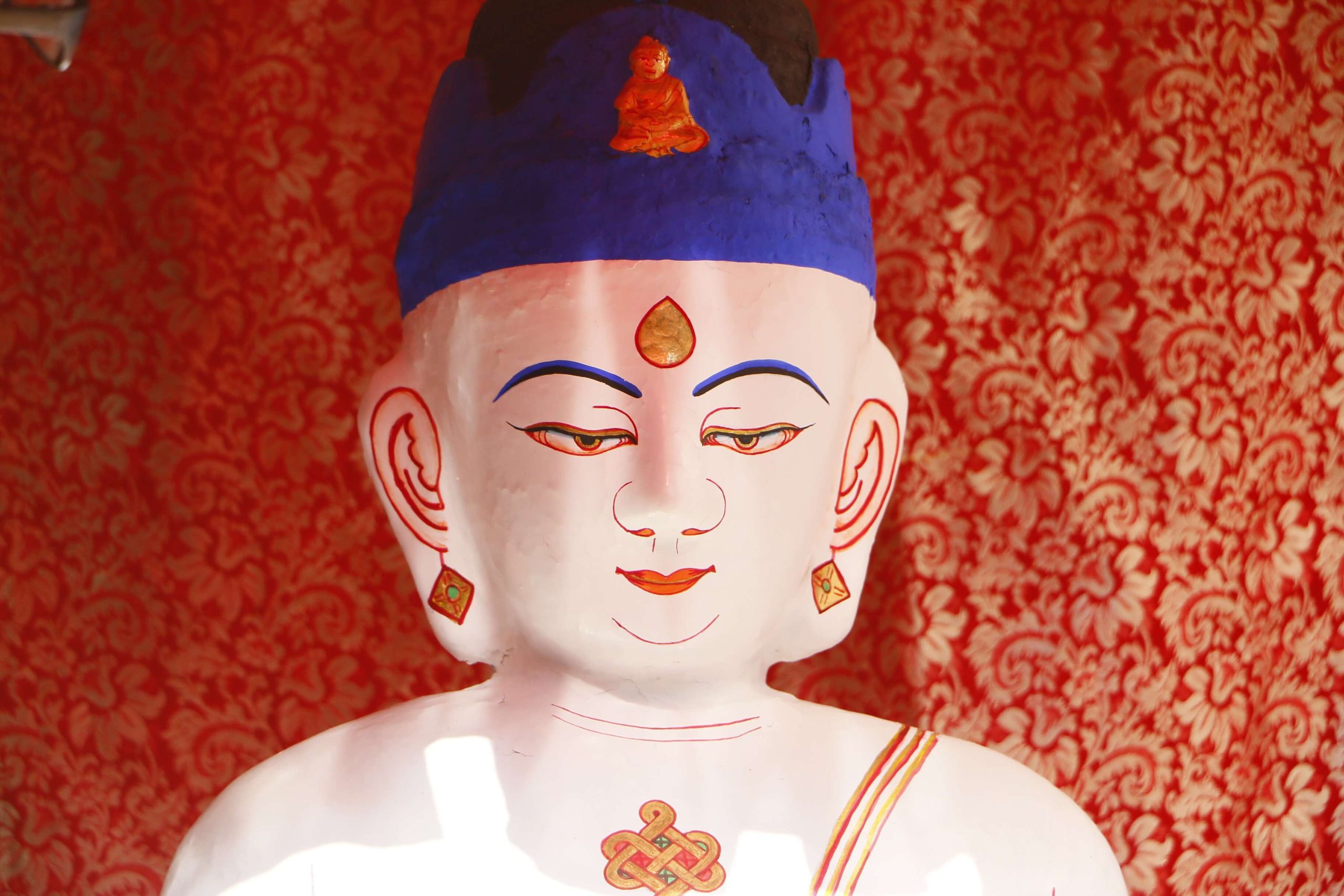
Mythological story behind Janabaha Dyo:
One of the most famous myth suggests that, in the 15th Century CE, when Kathmandu was ruled by the Malla dynasty, a beautiful image was dug up by a simple-minded farmer, known as a Jamami (meaning the one from Jamal) in present-day Jamal, which in that time was a separate geographical entity.
He took the image home for safekeeping, however in his sleep he dreamt of Lord Karunamaya, whose image it was. In his dream, he had been told by the deity that the proper place for it to reside is situated at the confluence of two rivers. The nearest confluence was at Whongha (in Nepal Bhasa) now popularly known as Indrachowk. Thus, Janabaha Dyo’s image was installed at the temple in the Buddhist monastery of Kanak Chaitya Mahavihar.
According to another myth, during the rule of King Yaksha Malla in Kantipur, people believed that bathing in the holy river and visiting Swayambhu led them to heaven after death. Upon learning about the power of Swayambhu, Yamraj (God of Death, ruler of the underworld) visited the holy shrine. However, during his return, he was captured by King Yaksha Malla and his tantric guru. They demanded immortality and refused to let Yamraj leave with their demands unfulfilled.
In this situation,Yamraj prayed to Aryavalokitesvara (Janabaha Dyo) for his freedom. His prayers were heard and the deity instantly appeared from the water. It was in white in color, eyes half closed and told the King to build a temple at the meeting point of Kalimati and Bagmati, and to organize a chariot procession so that it could visit the people with happiness and longevity.
Soon, the deity came to be revered highly as Jamaleshwor — the one found in Jamal. Eventually, his name got corrupted, as happens often in Nepal Bhasa, to Janabaha Dyo (Dyo meaning God). The courtyard where his temple is located is now popularly known as Janabaha.
Who is Janabaha Dyo:
It is the principal deity of the double-tiered gilded temple in Kanak Chaitya Mahavihar, one of the historical cores of Kathmandu city. The deity is a form of Bodhisattva and is renowned as a source of all energies that are said to help, guide and relieve a human mind of various difficulties. It is known by various names:
- Aryavalokiteshwor
- Avalokitesvaraa
- Karunamaya
- Lokanatha
- Jamaleshwor
- Seto Macchindranath (Hinduism)
- Guan Yin/Quan Yin (Chinese)
- Dzamling Karpo (Tibetian)
- Janabaha Dyo (local people)
Karunamaya is translated as a body of compassion since it is said to have the betterment of mankind at heart. The meditative half-closed eyes looking downwards represent their observation of the human world.
It is believed that Lokeshwors remained in the mortal world despite attaining Buddhahood (Budhatwo) in order to look after each and every living creature on earth and guide them towards the goal of achieving salvation. They wear the Amitabha Buddha statue in their head.
Religious significance:
It is believed that Karunamaya/Aryavalokiteswara (the compassionate one) came to this earth in prehistoric times with an altruistic view to eliminate the sufferings of all sentient beings and for the welfare of mankind. He is considered to be a protector of the whole world. Mahayani Buddhists (Newar Buddhists), Hindus & people from South East Asia worship Karunamaya/Aryavalokiteswara with great faith. He is also believed to be the teacher of Gorakhnath.
Pancha Rakshya Sutra is a Buddhist scripture dated around 200 CE in which Aryavalokiteshwor was counted among the eight major deities. Similarly, Sadharmapundarika, the 1st century CE Buddhist text, describes Avalokitesvara as the Bodhisatwo who liberates all sentient beings from suffering, as the great protector-one who protects from the eight fears.